Loading …
‘The Digital Lives of Young Indians’
An interactive collection of stories
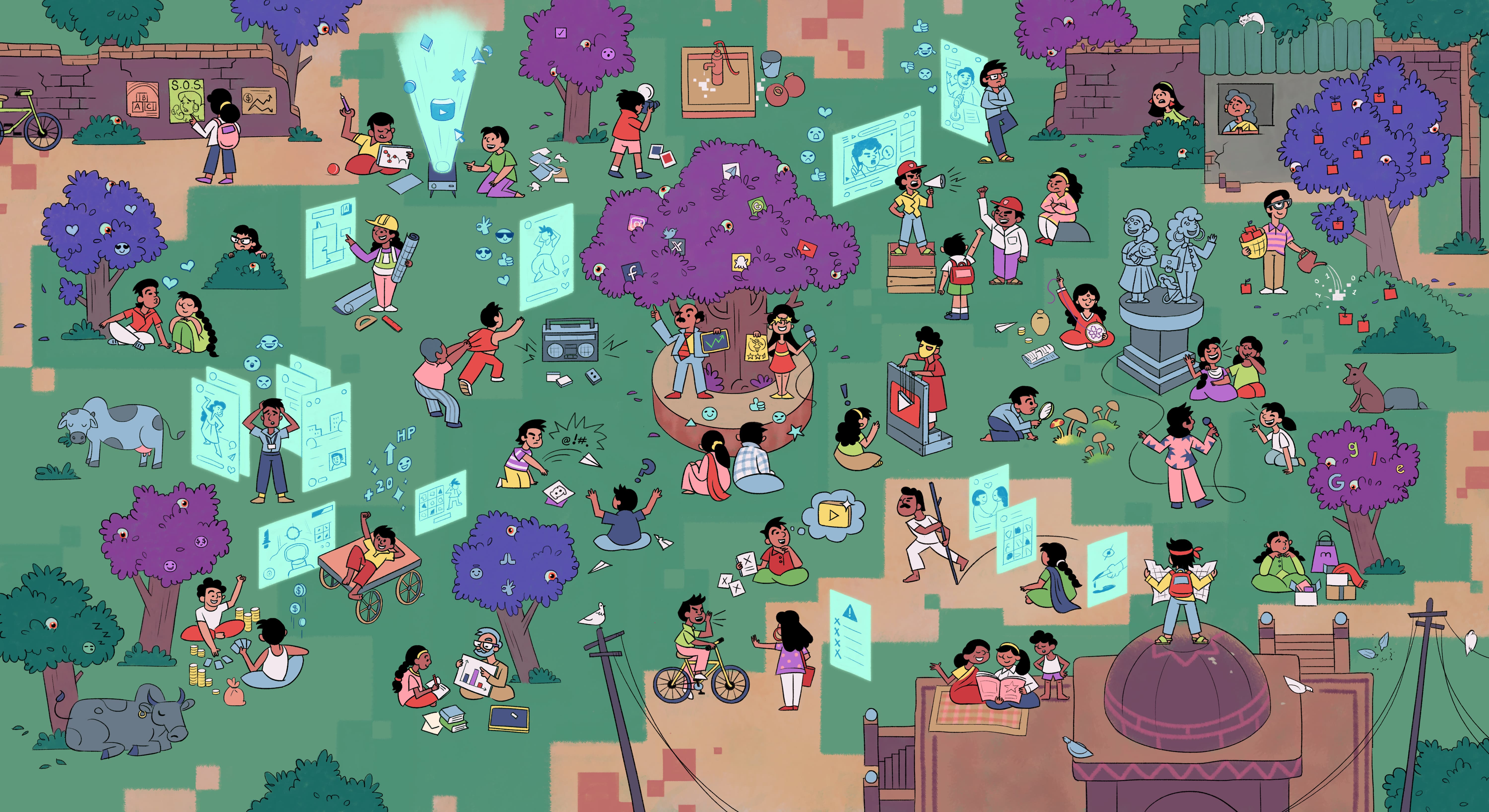
Explore how young Indians use, understand and experience social media
Scroll to begin
The proliferation of the internet has opened up a parallel universe for young people in India, one that resembles a maidan, a public ground. The internet is a public space where young people replicate and re-invent ways of being, similar to that of their physical lives. Much like a maidan with the winding trails, unexplored patches and many obstacles, young people make sense of the digital commons and navigate it in their own ways. In turn, the maidan takes shape through the young people who inhabit it.
To understand how young Indians experience social media, we spoke to 200+ people between the ages of 13 to 25 from government schools and industrial training institutes (ITIs) in India. These young people come from a mix of social and economic backgrounds, across urban and rural settings in five states in India including Gujarat, Odisha, Delhi, Kerala and Haryana. Here is what we heard from them.
“It is easier to talk to them (girls) online. The maximum they’ll do is block me” says Kishore from Gujarat. Just as a public space is experienced along deeply gendered lines, so is social media. Young women in India behave like wallflowers online – observing, treading carefully and participating from the sidelines. Young men, contrastingly, behave like brazen explorers – confident and bold risk-takers. The digital versions of young men and women mirror, amp up, or even tone down parts of their ‘real’ selves.
With few avenues to explore one’s identity, young Indians turn to social media platforms to form relationships and express themselves in different ways. In Gujarat, Radha and her friends, a group of young Adivasi girls, felt seen and happy when they came across a comedian online telling jokes in their native language. “He knows our lifestyle and struggles, and makes us laugh so hard.” Many young Indians, voice their interests and opinions, and explore national, religious and cultural identities online.
As you can see, the digital lives of young people in India are complex, messy, and honest. Social media is increasingly constructing young people’s reality. Yet, much understanding of youth’s interaction with social media in India is limited to the urbanised ‘middle-class’ youth, who are disproportionately represented. Our research attempts to uncover what happens inside the digital worlds of young people who come from marginalised and vulnerable communities. If the internet was a maidan, how would young Indians use, understand and experience different parts of its landscape? We collected stories that address this question. Scroll down to read their stories.